

New Research Explores the Role of D-Chiro-Inositol in Endometriosis: What a 2025 Study Reveals
Posted on Nov 2nd 2026 | By: Chiral Balance
D-Chiro-Inositol & Endometriosis
A closer look at emerging research into D-chiro-inositol, estrogen-related pathways, and cellular processes involved in endometriosis.
Endometriosis is a complex condition that continues to attract significant scientific interest. Researchers are exploring the biological mechanisms involved in its development, including estrogen-related signaling, cellular proliferation, inflammation, and tissue remodeling.
A 2025 study published in the journal Molecular Medicine has brought renewed attention to D-chiro-inositol (DCI), a naturally occurring member of the inositol family.
The study, titled D-chiro-inositol effectively counteracts endometriosis in a mouse model, investigated how DCI influenced several biological processes associated with endometriotic lesion development.
Although the findings are preliminary and based on an animal model, they offer interesting insights into the relationship between DCI and several cellular pathways currently being investigated by researchers.

Understanding the Science Behind Endometriosis
Endometriosis involves the presence of tissue resembling the uterine lining outside the uterus. Its development is associated with multiple biological processes, including:
-
Estrogen signaling: Estrogen plays an important role in the growth and activity of endometrial-like tissue.
-
Cell proliferation: The growth and multiplication of cells contribute to tissue development.
-
Angiogenesis: The formation of new blood vessels can help support developing tissue.
-
Inflammatory signaling: Inflammatory mediators are involved in the local tissue environment.
-
Epithelial-mesenchymal transition (EMT): A cellular process that can influence how cells change their characteristics, migrate, and interact with surrounding tissue.
Understanding these interconnected mechanisms is important to ongoing research into endometriosis.
What Did the 2025 D-Chiro-Inositol Study Investigate?
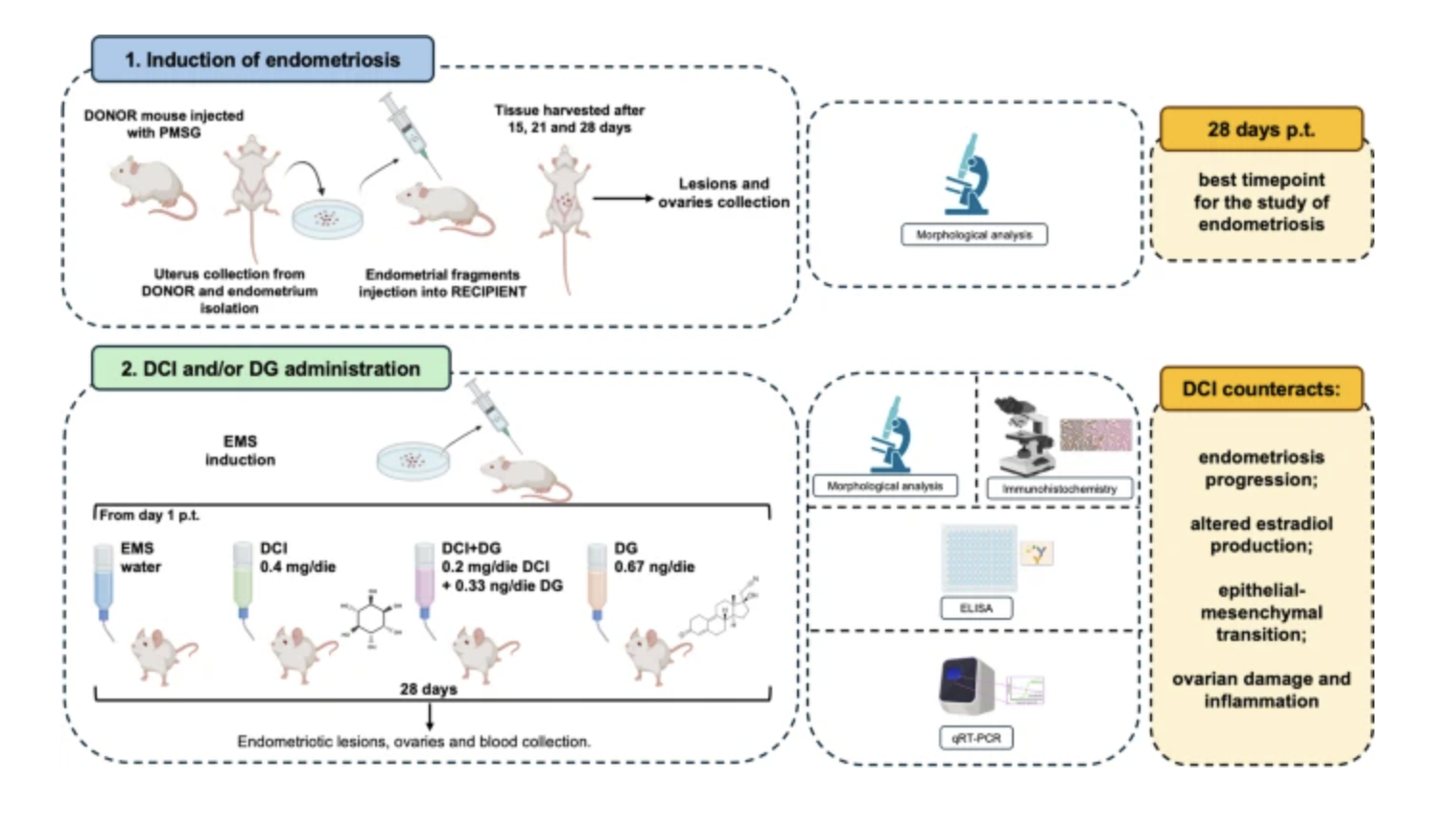
Researchers developed an experimental mouse model of endometriosis using transplanted endometrial tissue.
The mice were divided into four treatment groups:
-
Untreated endometriosis control group.
-
D-chiro-inositol (DCI) group.
-
Dienogest group, using a medication commonly prescribed for endometriosis.
-
Combined DCI and dienogest group.
The treatments were administered over 28 days.
Researchers then examined endometriotic lesions, ovarian tissue, circulating estradiol levels, and several molecular markers associated with cellular activity.
The objective was to determine whether DCI influenced biological processes associated with lesion development and ovarian tissue changes.
Five Important Findings From the Research
1. Reduced Number and Size of Endometriotic Lesions
One of the most notable findings was a reduction in the number and size of endometriotic lesions in DCI-treated mice compared with untreated controls.
The researchers also observed reductions in the vascularization of these lesions.
Vascularization refers to the development of blood vessels within tissue. This process is important because developing tissue requires an adequate blood supply.
The findings suggest that DCI influenced several characteristics associated with lesion development in this experimental model.
2. Changes in Aromatase Expression and Estrogen Levels
Another particularly interesting finding involved aromatase.
Aromatase is an enzyme responsible for converting androgens into estrogens. It plays an important role in estrogen biosynthesis.
Researchers found that DCI treatment was associated with:
-
Reduced ovarian aromatase gene expression.
-
Lower circulating estradiol levels.
-
Changes in biological processes associated with estrogen production.
Why is this important?
Estrogen signaling is closely associated with endometriosis biology. Researchers continue to investigate how estrogen production and signaling influence the development and persistence of endometriotic tissue.
The observed changes in aromatase expression and estradiol levels provide an additional area of scientific interest surrounding DCI.
Importantly, these findings do not establish that DCI regulates estrogen levels in women or should be used as an alternative to hormonal treatment.
3. Changes in Cellular Proliferation
The researchers also examined PCNA (proliferating cell nuclear antigen), a protein commonly used as a marker of cellular proliferation.
Their findings showed reduced PCNA-positive cells in endometriotic lesions from DCI-treated mice.
In simple terms, the researchers observed changes in a marker associated with cell multiplication.
This is significant because cellular proliferation is one of the biological processes involved in the development and maintenance of endometriotic tissue.
4. Changes in SIRT1 and E-Cadherin: Exploring Cellular Remodeling
Perhaps one of the more technically interesting aspects of the study involved two molecular markers: SIRT1 and E-cadherin.
These markers are associated with epithelial-mesenchymal transition (EMT).
EMT describes a process in which epithelial cells change their characteristics, potentially acquiring greater mobility and the ability to interact differently with surrounding tissue.
In endometriosis research, EMT is of interest because it may contribute to the ability of endometrial-like cells to migrate, attach, and interact with tissues outside the uterus.
The researchers observed changes in SIRT1 and E-cadherin expression following DCI treatment.
These findings suggest that DCI may influence molecular processes associated with cellular remodeling in this experimental model.
5. Observations Related to Ovarian Follicles
The study also examined ovarian tissue and follicular development.
Researchers observed that DCI treatment was associated with preservation of primordial follicles, which represent the earliest stage of ovarian follicle development.
They also reported an increase in developing follicles compared with the untreated endometriosis group.
These observations are scientifically interesting because ovarian tissue and follicular development are important areas of reproductive biology research.
However, the study did not establish improved fertility or reproductive outcomes in humans.
Why This Research Matters for the Broader Study of Inositols
D-chiro-inositol is one of several naturally occurring forms of inositol found throughout the body.
Together with myo-inositol, DCI participates in cellular processes involving phosphoglycans and insulin-related signaling pathways.
Although inositols have been studied extensively in connection with metabolic and reproductive biology, researchers continue to investigate their roles in other physiological processes.
This 2025 study adds another dimension to that research by examining DCI in an experimental model involving estrogen-related activity, cellular proliferation, and tissue remodeling.
It also highlights an important point: the biological effects of inositols may depend on the specific molecule, dose, tissue, and physiological context being studied.
Further investigation is needed to understand these relationships.
What We Still Need to Learn
While the findings are encouraging from a research perspective, several important questions remain unanswered.
-
Would similar effects be observed in human studies?
-
What mechanisms are responsible for the observed changes?
-
How do different DCI doses influence these pathways?
-
What are the long-term effects of DCI exposure?
-
How might individual differences in physiology influence the response?
The researchers used a mouse model and a 28-day treatment period. These results cannot be directly translated into a recommended human dosage or clinical treatment protocol.
Human clinical trials will be necessary to determine whether the observations have relevance to women with endometriosis.
 The Bottom Line: An Interesting New Direction in DCI Research
The 2025 study adds to the growing scientific interest in D-chiro-inositol and its biological activities.
By examining aromatase expression, estrogen levels, cellular proliferation, tissue remodeling, and ovarian follicular development, researchers identified several pathways influenced by DCI in an experimental mouse model.
It is an interesting contribution to the broader understanding of inositol biology and provides additional questions for future research.
At Chiral Balance, we believe that understanding the science behind individual nutrients is an important part of making informed decisions about nutritional health.
Scientific Reference
Placidi, M., Casoli, G., Vergara, T., et al. (2025). D-chiro-inositol effectively counteracts endometriosis in a mouse model. Molecular Medicine, 31, Article 134.
https://doi.org/10.1186/s10020-025-01178-6
Research note: This study was conducted in mice. It does not establish D-chiro-inositol as a treatment or prevention strategy for endometriosis in humans. This article is for educational purposes and is not intended as medical advice.